Boulder opal: why the ironstone stays
Most opal work is about separating the color from its host rock. In Queensland boulder opal, the ironstone is the point.
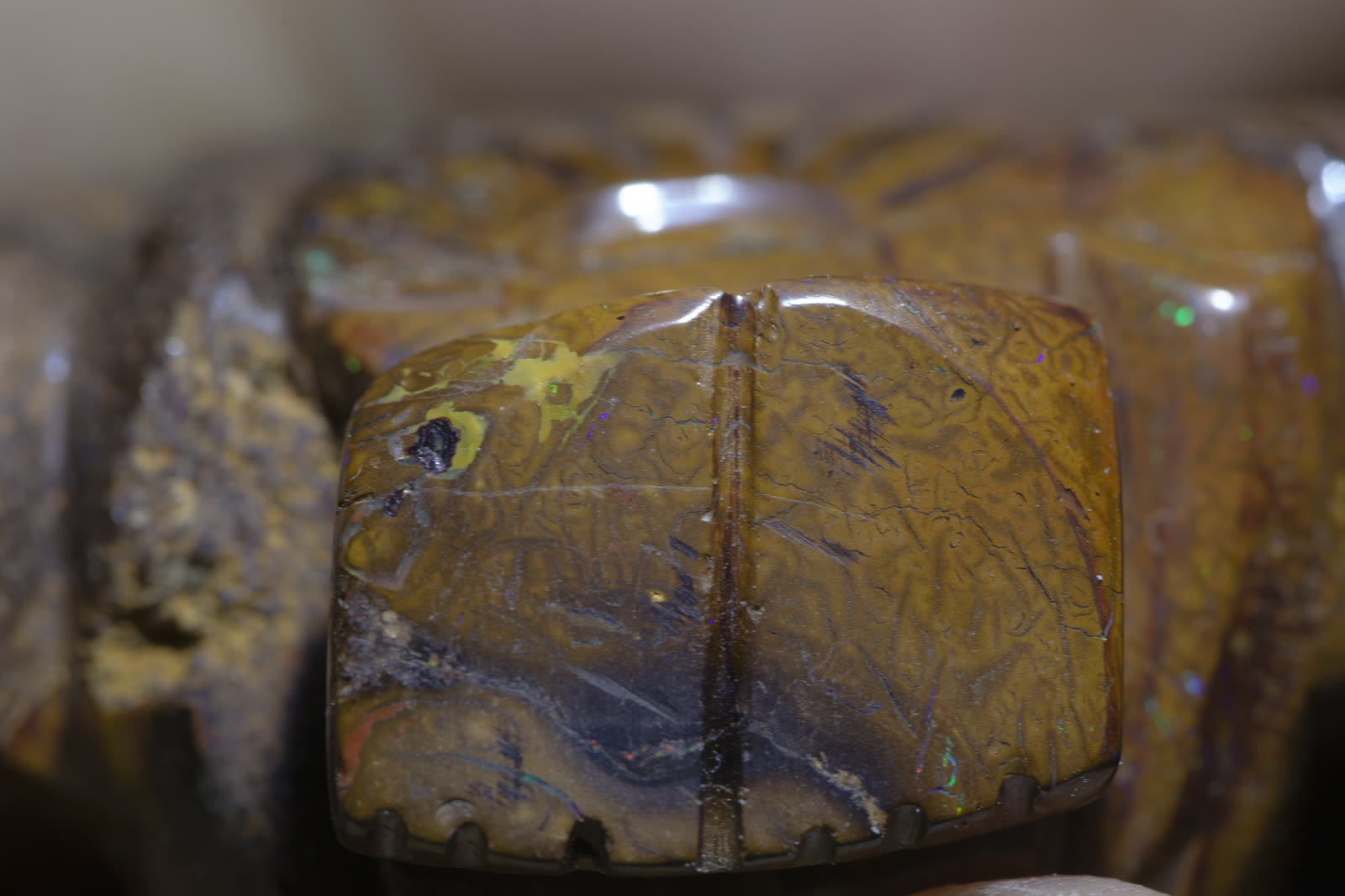
With most opal — Ethiopian, Lightning Ridge, Virgin Valley — the goal is to separate the color from its host material. You grind away the matrix, shape the color layer into a cab, polish. The host rock is waste.
Queensland boulder opal is different. The color forms in thin veins through ironstone — a dense iron oxide rock from the western Queensland outback. The color layer is often too thin to cab on its own; remove the ironstone and you have a fragile wafer. Leave it on, and you have a stable piece with a surface of color and stone that's unlike anything else in the opal world.
Koroit and the fossil patterns
Koroit material — from the Koroit station area in southwest Queensland — has a specific character: ironstone invades the color zone in dendritic, moss-like, or honeycomb patterns. The color fills the voids between the iron; the iron creates the pattern. What you might call an inclusion in any other stone is here the whole aesthetic.
The slabs in this photo are Koroit-style. That brown patterning running through the color isn't contamination — it's the ironstone doing exactly what makes these pieces desirable. Polished flat, the contrast between the color bar and the matrix is something that can't be replicated. No two slabs from the same seam look the same.
Yowah nuts
The other famous Queensland boulder type is the Yowah nut — a roughly spherical ironstone concretion that sometimes contains an opal core. From the outside they all look identical: dark, heavy, featureless. Crack one open and you either find potch, color, or nothing. It's a gamble that's been running in the outback for a long time.
Boulder opal takes different tools and a different mindset than Ethiopian or Lightning Ridge — you're not trying to eliminate the host material, you're collaborating with it. Some of the best pieces we've worked with are 80% ironstone. The color is in the other 20%, and that's enough.