Pin fire
Pinfire is the densest play-of-color pattern — thousands of tiny points packed across the face. The still water stone is one of the better examples on the bench.
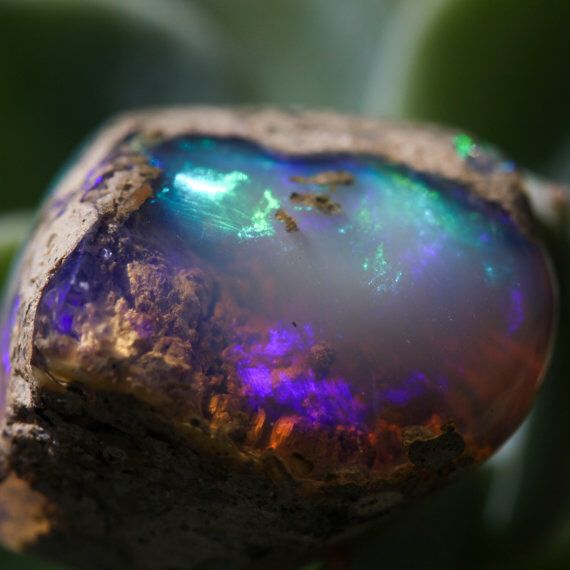
Opal play-of-color falls into broad pattern categories based on how the color presents: rolling fire is large sweeping zones that shift as the stone moves; harlequin is angular patches arranged in a roughly geometric mosaic; pinfire is a dense field of tiny individual points. Under magnification the points are distinct. With the naked eye they read as a shimmering surface rather than a series of flashes.
The still water stone earned its name from exactly that surface quality. The color doesn't sweep or flash — it sits across the face the way reflected light sits on still water. Even and continuous, shifting slightly as the viewing angle changes but never switching on and off in patches. It photographs well compared to rolling-fire pieces because the points are stable regardless of shutter timing. What the camera misses is the depth — the sense that the color is slightly inside the stone rather than on the surface.
What produces pinfire
The pattern comes from the grain size of the silica sphere domains. Rolling fire has large, coherent domains — big zones where the lattice is uniform, each diffracting one color across a visible area. Pinfire has very small domains, densely packed, each only a fraction of a millimeter across. The eye can't resolve individual points without magnification, but there are thousands of them. The result is the fine-grained shimmer the pattern is named for.