Reading red fire
Red is the rarest spectral color in play-of-color opal. Here's why, and what it looks like in rough.
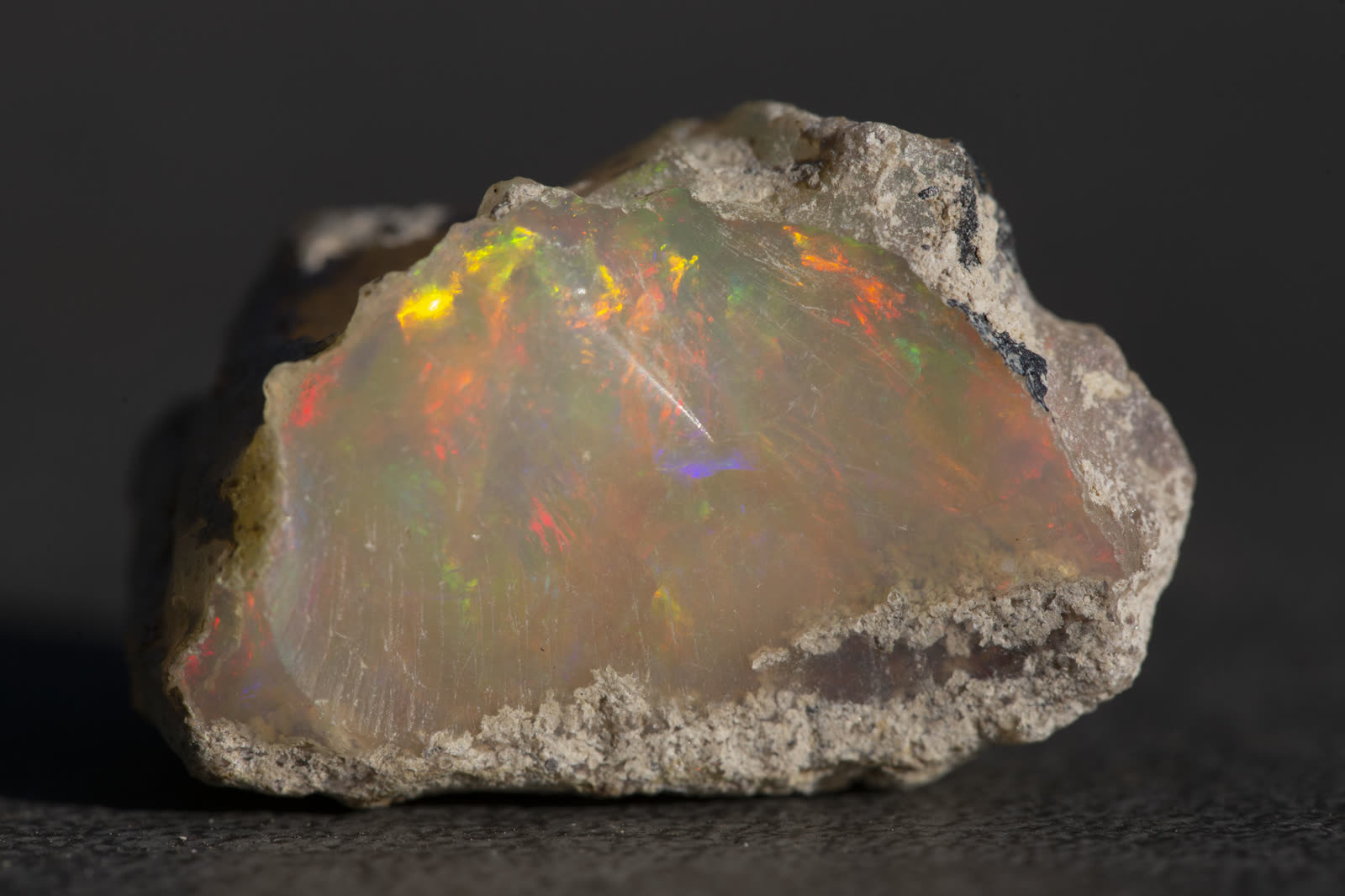
Play-of-color runs across the visible spectrum — violet and blue on one end, red and orange on the other. The colors you see in any given opal depend on the size of the silica spheres in the lattice and how consistently they're stacked. Smaller, more uniform spheres produce shorter wavelengths: blue, violet. Larger spheres produce longer wavelengths: orange, red.
Red is the longest visible wavelength, which means it requires the largest, most precisely ordered silica spheres. Getting that consistency in a natural gem is rare. Most opal shows green and blue readily — those wavelengths are produced by a wider range of sphere sizes. A clean, dominant red flash means the lattice is very precisely ordered across a significant area. That's why red-dominant opal commands a premium.
What it looks like in this piece
The red here is broad and dominant across the top face — not a spot or a pinpoint but a field. The orange and yellow that accompany it follow naturally from the same large-sphere lattice producing adjacent wavelengths. The blue zones visible at the edges are where the color bar transitions to a different sphere arrangement. In a finished cab, the cutter's job is to orient the stone so the face captures the red-dominant zone and the cab dome maximizes the sweep of color across the viewing angle.
This piece is still in matrix and in evaluation. The color visible on the surface extends across the full face, which is encouraging — it suggests the color bar is thick enough to survive the preforming process. How deep it runs is the question the saw answers.