Carving opal: when a bur replaces a flat lap
Most opal cutting happens on flat wheels. Carving is different — three-dimensional work with diamond burs, done slowly.
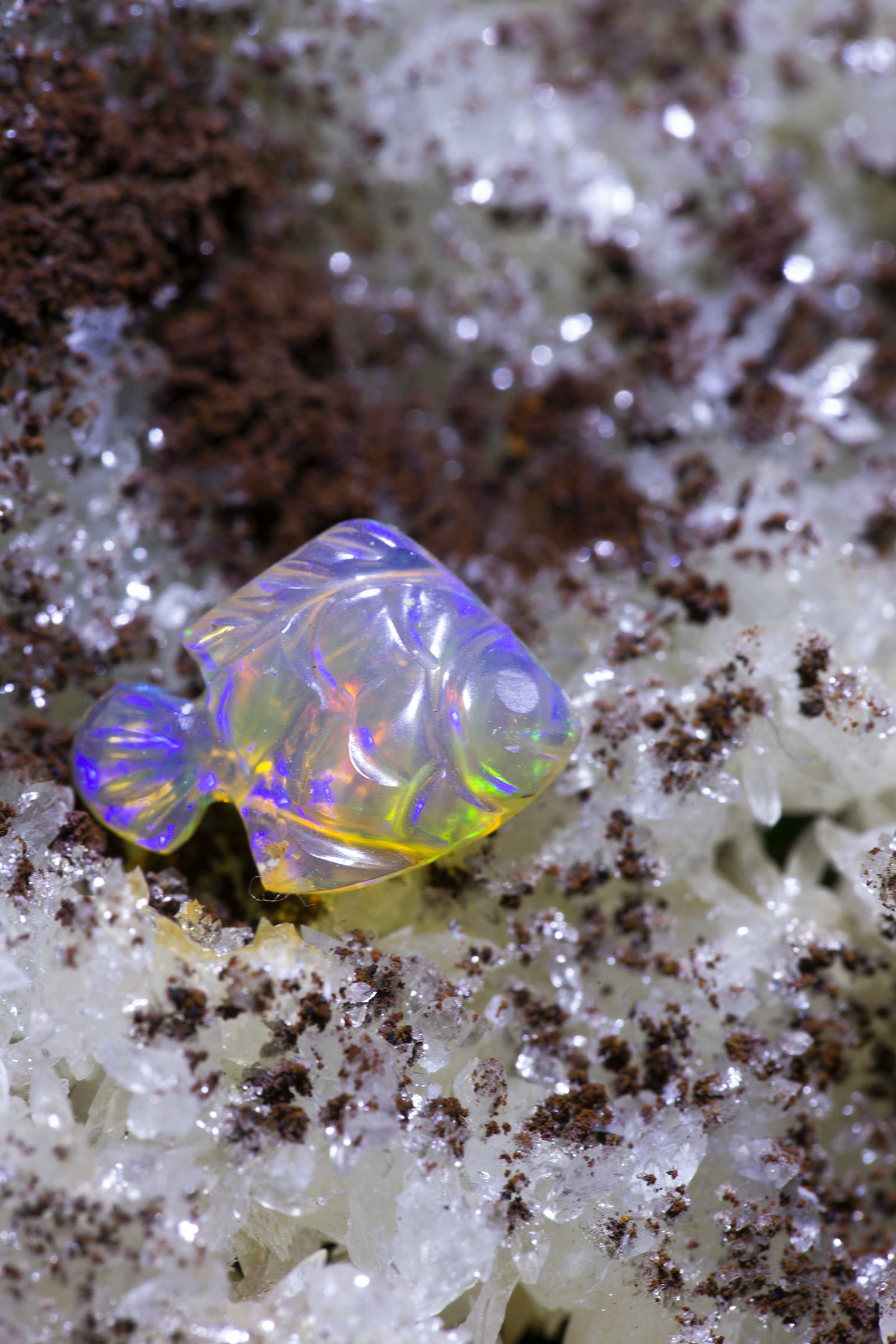
Standard cab cutting works on flat or convex grinding wheels. Carving uses ball-shaped and tapered diamond burs in a rotary handpiece or flex shaft, cutting three-dimensional forms into the stone rather than grinding down from a flat surface. The fish in the photo above went through three sessions of large-form work before any detail was added. That is the most important principle in opal carving: work large to small. Get the overall mass and proportions right before attempting any surface texture or relief.
The early-carver mistake is starting with detail. A fine bur and a light touch feel like progress — fine lines appear, texture develops — but if the overall form is wrong, the detail work is wasted. Establish the silhouette in rough outline first. Then refine the mass. Then add surface quality. Then detail, if any.
Speed and pressure
Carving runs slower than grinding. The bur is at a lower RPM and each cut is deliberate. Opal moves under burs quickly; too much speed and pressure together can fracture the stone or generate enough heat to craze the surface. Keep the bur wet, work in short passes with light contact, and check the stone frequently. The material changes faster than you expect.
Finishing a carving means polishing compound on small felt or muslin buffs, working into the carved contours. Interior surfaces of carved recesses require small-diameter points. The goal is identical to a flat cab — every surface carries a consistent, scratch-free polish — but the geometry makes it slower and requires more tool changes.