Faceted opal: the other way to cut
Most opal cutters cab. Here's why — and the one type of material where faceting actually makes sense.
Most opal cutters cab. That's not laziness — it's what the material asks for. Play-of-color lives in a flat diffraction layer, and the most effective way to show it is a smooth dome directly over that layer. Facets cut through it at angles and break the fire into fragments.
So why facet at all?
Crystal opal changes the math
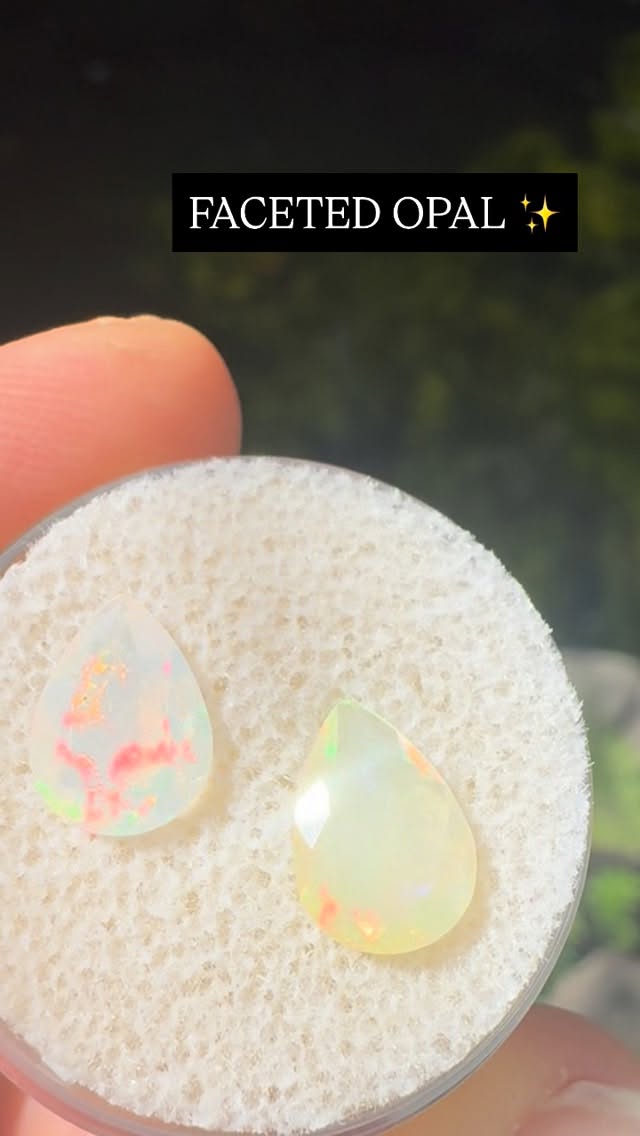
Ethiopian crystal opal has a water-clear to slightly foggy base — sometimes almost no body color to speak of. In this material the play-of-color can be seen through the stone as well as on the surface. Faceting does something a cab can't: the facets catch light the way a regular gem would, and the color fires through the interior at the same time. Two things happening at once.
The teardrops here are from the same rough parcel — same origin, same general material. Side by side you can see what individual character does: the left piece has a broader, more floral pattern; the right one is electric pinfire, small consistent silica spheres that produce a sparkle rather than a sweep.
Faceted opal is a harder sell than cabs. Buyers expect opal to look a certain way — rounded, smooth, color rolling across a dome. A faceted piece surprises people who aren't expecting it. Worth the look, though. Hard to put down.