Fire on black
The same play-of-color on a dark body and a light body are not the same thing. Here's why dark body opal looks the way it does.
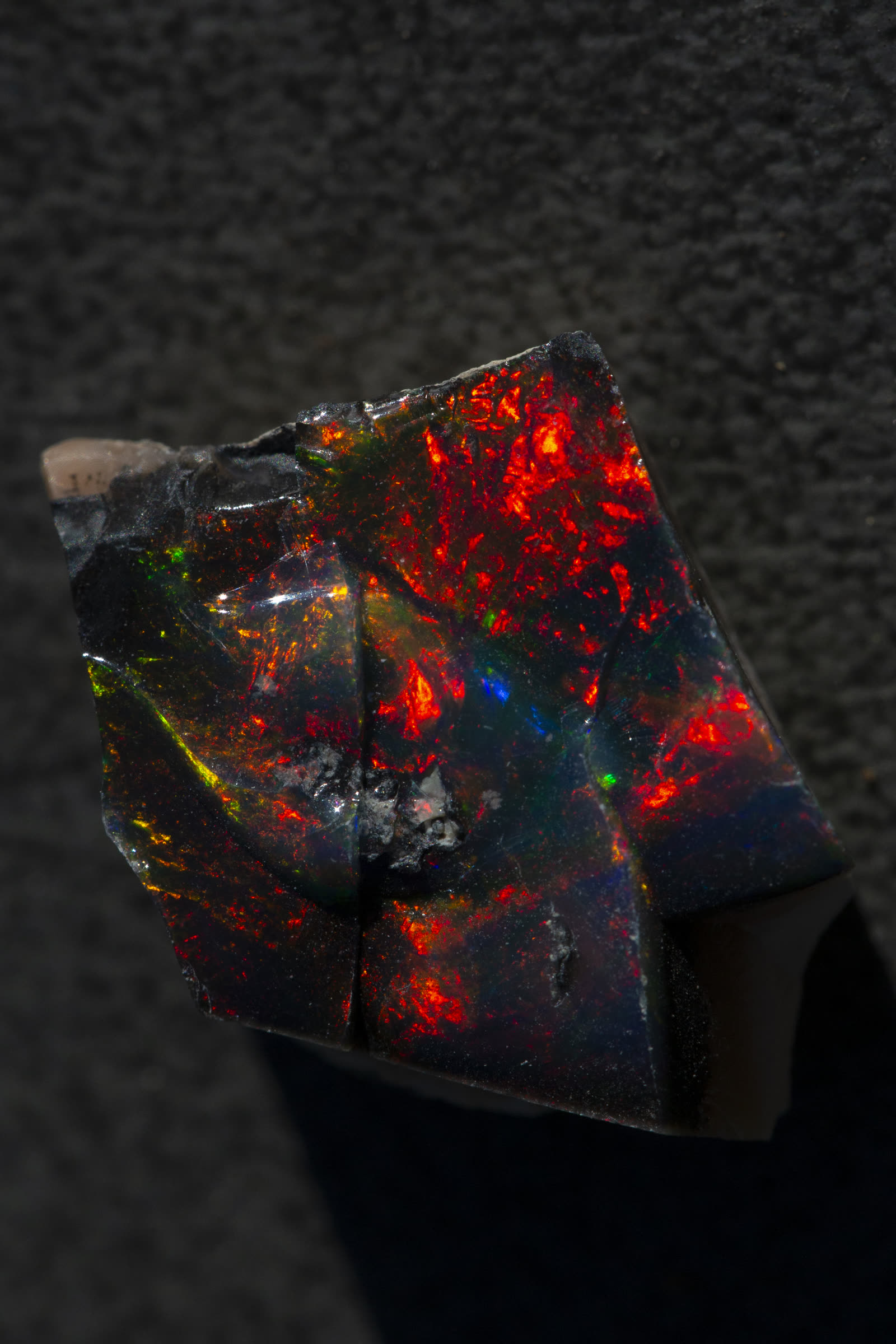
The play-of-color in opal is light diffracting through a lattice of silica spheres. That process is the same in a black stone as in a white stone. What the body tone changes is the contrast. A dark body absorbs light that isn't diffracted instead of scattering it back. In a white or crystal stone, the background light bouncing back competes visually with the play-of-color. In a dark stone, there's nothing competing. The color reads against black.
The practical result is that the same color bar that would look pleasant in a white stone looks electric on a dark body. Red fire that reads as a nice warm red in a light base looks almost molten on near-black. Orange becomes luminous. Green goes vivid in a way that doesn't happen in the same stone on a white ground. The dark body tone isn't generating the fire; it's removing everything that dilutes it.
Why it costs more
Dark body opal commands a premium because the visual effect is stronger, not because the underlying stone is physically different from a comparable light-body piece. The same quality color bar is worth more on a dark body because it looks better. That premium is real and consistent across the market. When you're looking at two stones with similar play-of-color, the difference in body tone is probably most of the difference in price.