Nevada opal country: the geology of Virgin Valley
The northwest corner of Nevada sits on ancient volcanic ash layers. Here is what that means for the opal that forms there.
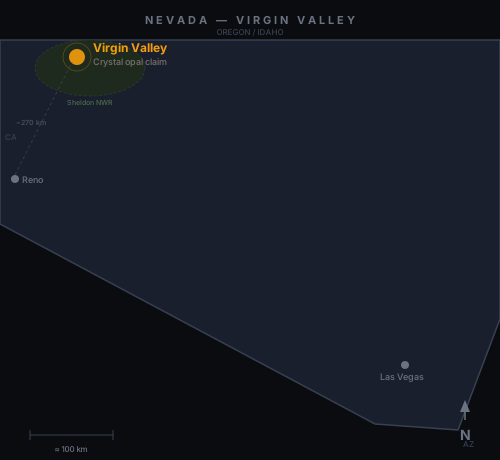
Virgin Valley sits in the far northwest corner of Nevada, inside a basin ringed by low desert ridges and bordered on the north by the Sheldon National Wildlife Refuge. The valley looks like most of the Great Basin — sagebrush, antelope, alkali flats. What is under the surface is different. The valley sits on a thick sequence of ancient volcanic ash layers that became bentonite clay as the silica reacted with water over millions of years. Opal forms in that clay.
The formation process: silica-laden groundwater moves slowly through the porous ash layers and precipitates opal in voids, along fractures, and around buried organic material. The organic replacement is spectacular — wood from ancient trees has been replaced molecule by molecule with silica, producing limb casts and wood replacement opal that preserves the original cell structure. Crystal opal, common opal, and the limb casts all come from the same basic process: silica precipitating in whatever space the groundwater reaches.
Why it is different from Australian opal
Australian opal forms in sedimentary environments — ancient inland seas and lake beds in cretaceous-age mudstones. The rock has been dry for a long time. Virgin Valley material is still in a relatively wet deposit, and fresh-dug opal can carry 15 to 20 percent water by weight. That water is structural — it fills the spaces between the silica spheres that produce play-of-color. When it leaves unevenly, the stone crazes. It is the same mineral, same optical phenomenon, fundamentally different stability profile.