Orange fire in Welo
Most Ethiopian opal plays blue and green. The pieces that throw orange are rare enough that when you find one in a parcel, you set it aside.
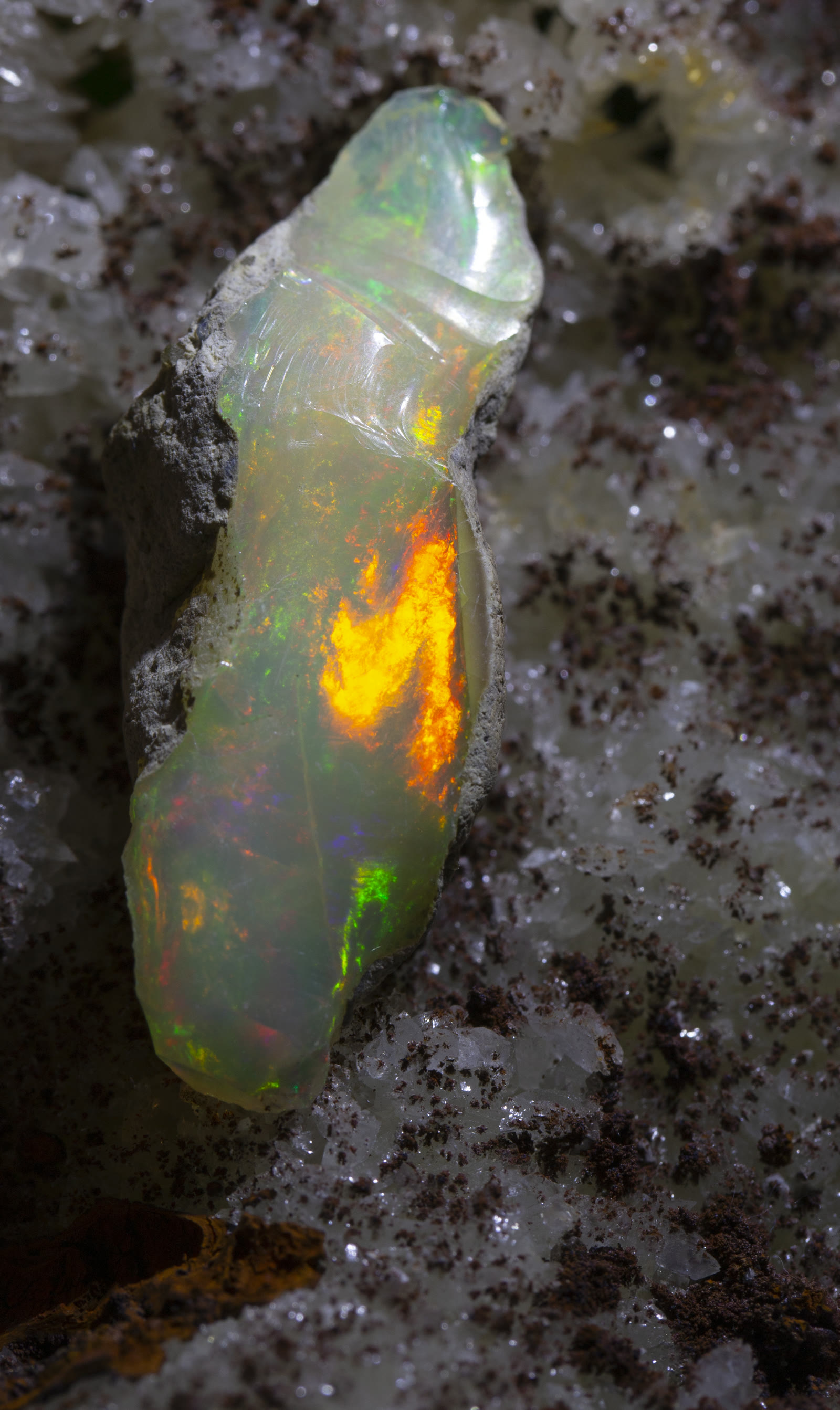
Ethiopian Welo opal tends toward the cool end of the spectrum. Blue, green, violet — those are the common flashes. Warm colors exist, but orange is uncommon, and a strong saturated orange that holds across the face of a stone is genuinely rare. When you buy rough by the parcel, you might go through fifty grams before you find one piece throwing that color.
The orange comes from the same diffraction geometry as blue, just with a different silica sphere spacing. Blue requires spacing around 240–280 nanometers. Orange sits closer to 340–360 nanometers. The stone itself doesn't know it's rare — the spacing is what it is. But from a cutting standpoint, orange Welo is worth slowing down for.
Not to be confused with fire opal
There's a naming confusion worth clearing up. "Fire opal" is a specific gem category — usually Mexican, body color ranging from yellow to deep orange-red, valued for that body color alone, and often transparent with little or no play-of-color. What we're talking about here is Ethiopian opal that happens to display orange play-of-color. The body color is white or clear. The orange is the diffraction pattern, not the stone itself.
When you cut an orange-flash Welo, the orientation matters more than usual. The color tends to be directional — it reads strong face-on, weaker from the side. A good cut aligns the broadest face of the cab to where the orange lives. Get it wrong and you've taken a rare stone and made it look average.
What to look for in rough
In uncut rough, orange fire can be easy to miss. The stone looks dead until you hit it at the right angle under a direct light source. I use a small LED flashlight held close to the stone and rotate slowly. The orange will pop in a narrow window of rotation — note that angle, because that's where your cab table needs to end up.
Potch content matters too. Ethiopian rough often comes with a white or grey backing. That backing acts as a diffusion layer and amplifies the color you see through the face. If you remove all the potch trying to save weight, you sometimes kill the orange. Leave enough base to let the stone work.