The cutting process: rough to cab
What happens between a piece of rough opal and a finished cabochon. The full sequence.
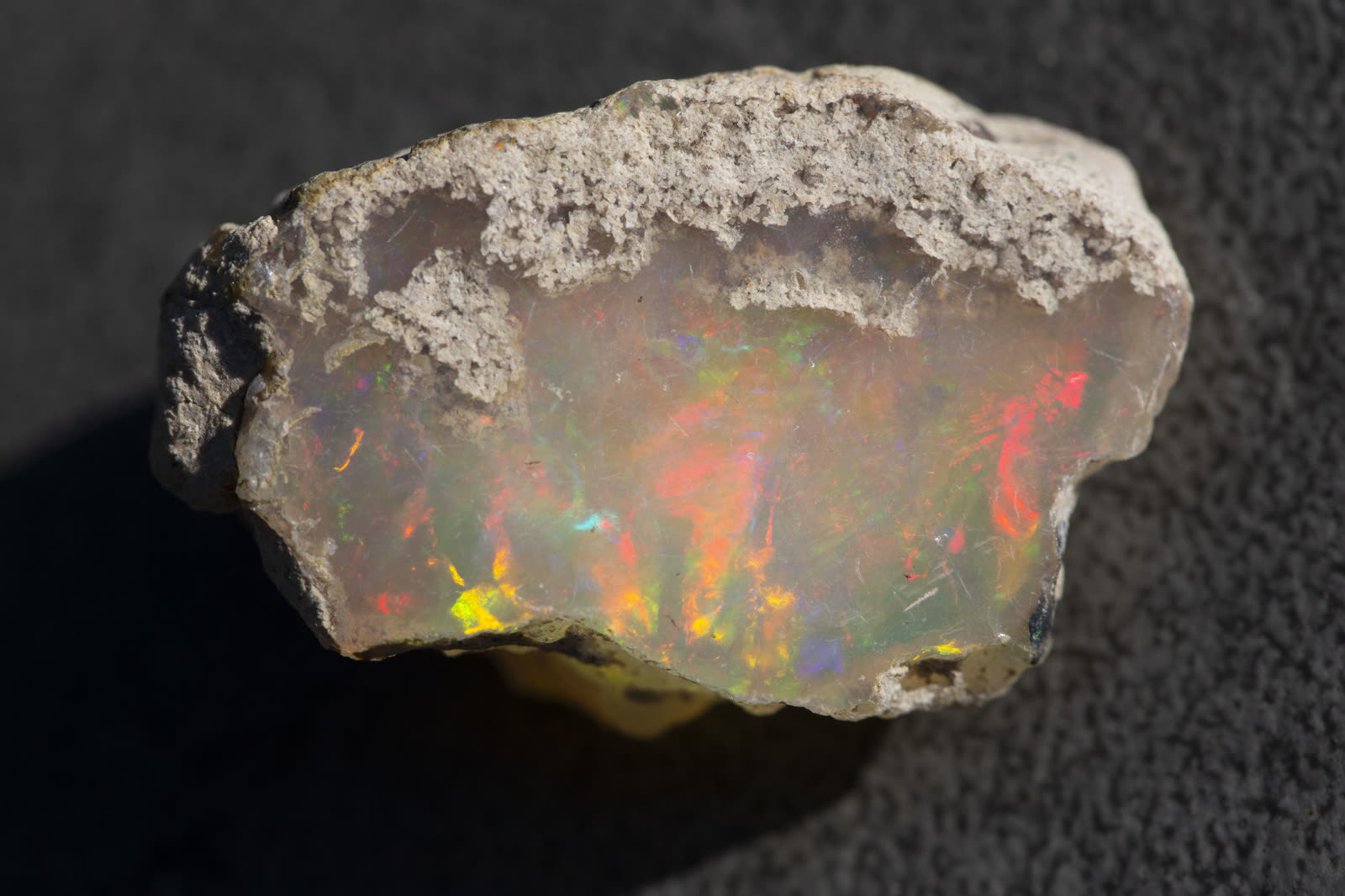
The cutting sequence has five stages: evaluate, preform, grind, pre-polish, polish. They run in that order and skipping any one of them creates a problem that shows up later. Evaluation comes before the first saw pass because the decisions you make there determine everything that follows.
Evaluation: find the color bar, map its orientation relative to the surface, look for fractures or inclusions. The color bar is what you are cutting toward. Its angle, depth, and width determine what dome geometry makes sense. Fractures determine what size is possible — some pieces only yield a small cab because the usable material is bounded by fractures on both sides.
Preform, grind, polish
Preforming: rough-shape the stone on a coarse wheel or trim saw to establish the cab outline and remove bulk material before using expensive fine-grit wheels. The preform gets the stone close, not finished.
Grinding: run through a grit progression from coarse to fine — 220, 400, 600 or 800, 1200, 3000. Each stage removes the scratches from the previous. Every stage runs wet. Opal requires lighter pressure than harder gems throughout.
Polish: leather or felt wheel with cerium oxide compound at low speed. The test is the point-source reflection in the dome — sharp and clean means done. Every stage prepares the surface for the next. Polish reveals the quality of everything that preceded it.