What the back tells you
Everyone photographs the face. Turn a rough opal over and you learn what you're actually working with.
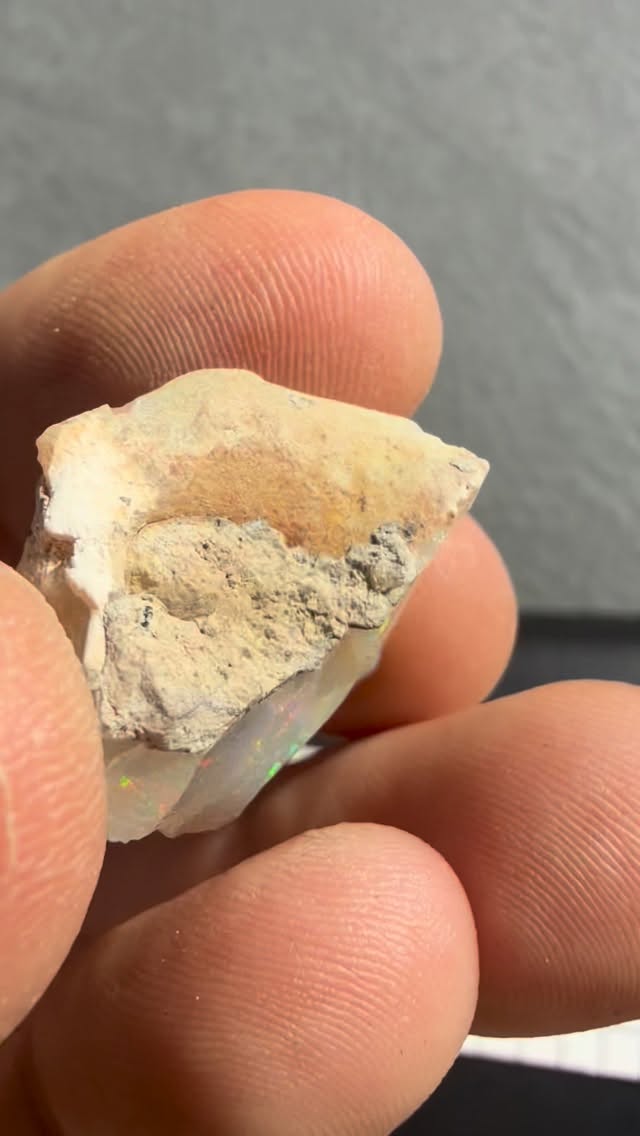
Everyone photographs the face. The back of a rough opal is where you actually learn what you're dealing with.
Potch
Potch is common opal — the same silica structure as precious opal, but without the ordered sphere arrangement that produces play-of-color. It's sandy, chalky, or translucent. In good rough, the color bar sits between potch on both sides: you have room to work and material to grind away. In thin pieces the potch is almost gone, and you're already close to cutting straight through the color.
Matrix
Matrix is the host rock still attached to the opal. In Ethiopian material it's usually a sandy or chalky sedimentary layer. In Queensland boulder opal the ironstone matrix stays attached by design — the iron is part of what the finished stone looks like. In this photo you can see the matrix band at the top: that's where the piece was still attached to its sandstone seam when it came out of the ground.
Fracture lines
A crack that stays entirely in the potch layer might grind away before you ever reach the color bar. One that cuts through the color bar is a real problem — either on the wheel, or later as the piece is worn. Reading fractures before cutting is most of what separates a good outcome from an expensive lesson.
The piece in this photo has a solid matrix back and a narrow color zone showing at the bottom edge. That's honest rough. You know exactly what you're working with before a wheel touches it.