Wire wrapping: setting without heat
Standard settings use heat somewhere in the process. Opal doesn't like heat. Wire wrapping is how you set a stone cold.
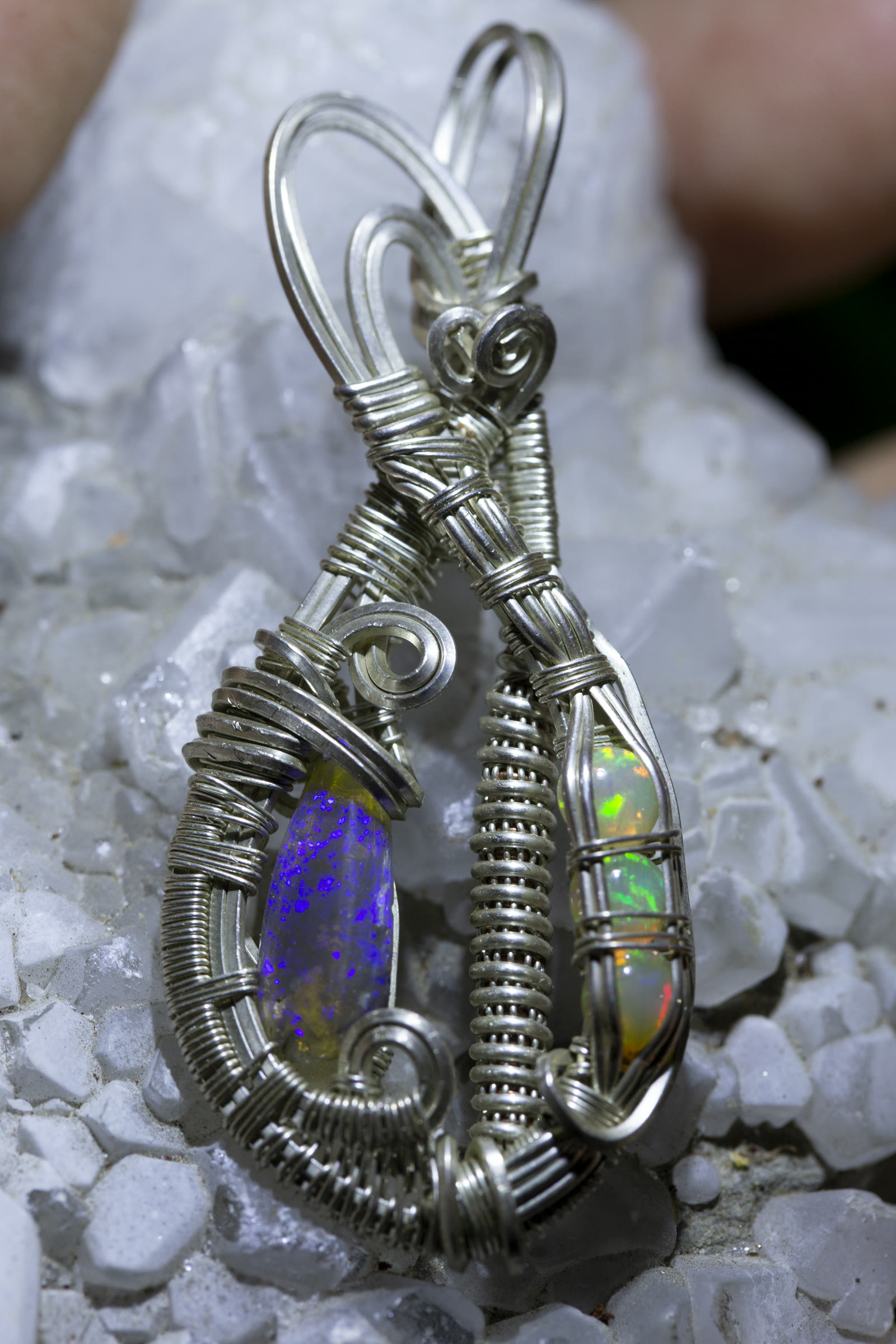
Standard jewelry settings — bezel, prong — require heat somewhere in the process. Bezels need to be soldered to the base; prongs need to be hardened. Heat and opal don't mix well: opal can crack from thermal shock, and the micro-porous structure of Ethiopian hydrophane can lose its internal moisture too fast under torch heat.
Wire wrapping is cold-work, start to finish. No torch, no solder. The wire is shaped around the stone mechanically — bent, coiled, tensioned — and the structure it creates holds the opal without adhesive or heat.
How this pendant came together
The piece here holds two opals in one frame — a darker stone on the left with deep blue and violet, and a lighter crystal piece on the right with warm red and green pinfire. Pairing them in one pendant means the wire structure has to hold two different shapes and weights while keeping the whole thing balanced.
The wire is fine silver in two gauges. Heavier gauge creates the structural skeleton — the main loops that actually seat the stones. Fine wire wraps tightly over the structural wire for texture and to lock the coils in place. The decorative spirals at the top are the same fine wire, shaped by hand.
Mistakes don't buff out. If you overbend a section of wire it work-hardens and can't be undone cleanly. Every wrap is effectively permanent. It's the kind of work that benefits from planning the full structure before you pick up the first piece of wire.
For freeforms and naturals — stones with irregular shapes that wouldn't sit cleanly in a standard bezel — wire wrapping is often the only approach that shows the whole stone. A bezel swallows the edges. Wire lifts the stone and leaves all sides visible.